
You’re Good at the Work. Going Out on Your Own Is a Different Job.
TLDR
- Get legal to sell the work: license, insurance, and a business name that can get paid.
- Price like a business. Your old hourly wage is not your rate.
- Separate the money on day one and keep the books current from job one.
- Put quotes, jobs, and invoices in one system so nothing lives only in your head.
- Build a way to get work that is not your old boss’s dispatch board.
What changes: no Friday paycheck, you are now sales and office and tech, and the customer is hiring a business, not a skilled employee with a truck.
You’ve been the one they send when the job is ugly. You show up, you fix it, you don’t leave a mess. For years that was enough, because someone else found the customer, priced the work, bought the insurance, and put money in your account on Friday.
Going out on your own does not make you a better tradesperson. It makes you the person responsible for everything the company used to handle while you were on the tools. Most people who struggle at this don’t fail at the work. They fail at the layer they never had to see.
1. Get legal to sell the work
Skill is not a license. In a lot of states and trades: electrical, plumbing, HVAC, roofing; you cannot legally pull the work, advertise it, or collect on it until you are licensed. Rules differ by state and even by city. Check yours before you print the van.
Insurance is the other door. General liability is what homeowners and general contractors ask for before they let you in the house. If you hire anyone, workers’ comp is usually not optional. Commercial auto matters the day the van is a business vehicle. Nobody at the supply house will remind you. The first claim will.
Then the boring paperwork that lets you get paid cleanly: a business name, an EIN so you are not handing out your Social Security number, a business bank account, and a decision on sole prop versus LLC. An hour with an accountant before you pick a structure is cheaper than guessing.
2. Price like a business, not like an employee with a truck
This is where good techs undercharge themselves into a worse job than the one they left.
Your old wage covered your time. It did not cover the truck payment, insurance, fuel, tools that walk off, the hour you spent quoting and didn’t win, the slow week in February, or the taxes nobody withholds anymore. If you bill what you used to make per hour, you just bought yourself a pay cut and a second shift.
Build the price from the costs, not from what feels polite:
- Labor at a rate that still pays you after taxes and slow weeks
- Materials with a markup, not at cost
- Truck, insurance, phone, software, and the hours you are not billable
- A little room for the job that goes sideways
Write it down once. Use it on the next ten quotes. Adjust from real jobs, not from the neighbor who said “my guy does it cheaper.”
3. Separate the money, and start the books on job one
The fastest way to feel busy and broke is one checking account for the mortgage, the material run, and the customer deposit.
Open a business account before the first check lands. Pay yourself from it on a schedule, even a small one. Save for taxes as you go, nobody is withholding anymore, and quarterly estimates surprise people who were excellent employees.
Invoice the day the job is done. Collect a deposit on bigger work. Do not let “I’ll send it this weekend” become how the business runs.
This is the layer TradeBuilder HQ is built for. Getting Started (from $975/mo, up to 4 users) includes bookkeeping and monthly reporting, QuickBooks Online setup, contractor payments and 1099 prep, and estimate, invoice, and payment workflows. You do not have to hire a full office to stop mixing the money. You do have to stop being the only system holding the books together.
4. Put the jobs in one place before the notebook fills up
When you worked for someone else, the board told you where to be. Now the board is you. Quotes in texts, jobs in your head, invoices as photos, that holds for about three customers. Then something slips, and the slip is money.
Pick a simple CRM in week one:
- Jobber — quotes, scheduling, invoicing, and a client hub. Built for home service.
- Jobtable — lighter quotes, jobs, invoices, and client records.
What “done” looks like: the next job is on a calendar, the estimate went out from the system, and there is a reminder to follow up if they go quiet. TradeBuilder HQ sets that CRM and the payment workflow up so it matches how you actually work, not a software demo.
5. Build a way to get work that isn’t your old dispatch board
The first month often feels fine. Old coworkers send you side work. A neighbor needs a water heater. Then that well goes quiet, and you realize nobody is feeding you jobs anymore.
You do not need an agency retainer to start. You need a short list you can actually do:
- Tell past coworkers, suppliers, and the GCs you already know you are taking work — with a license and insurance certificate ready.
- Claim Google Business Profile, add real job photos, and ask every happy customer for a review the day you finish.
- One local sponsorship you can afford: a youth team or a fence banner so your name is in the neighborhood before someone needs you.
- If you want paid search without a big-agency minimum, TradeBuilder HQ’s Google Ads management gets you up and running: campaigns you approve, daily adjustments, conversion tracking, and reporting in plain language. You keep the account.
Getting work is now part of the job. Treat it like one, or the tools stay in the van.
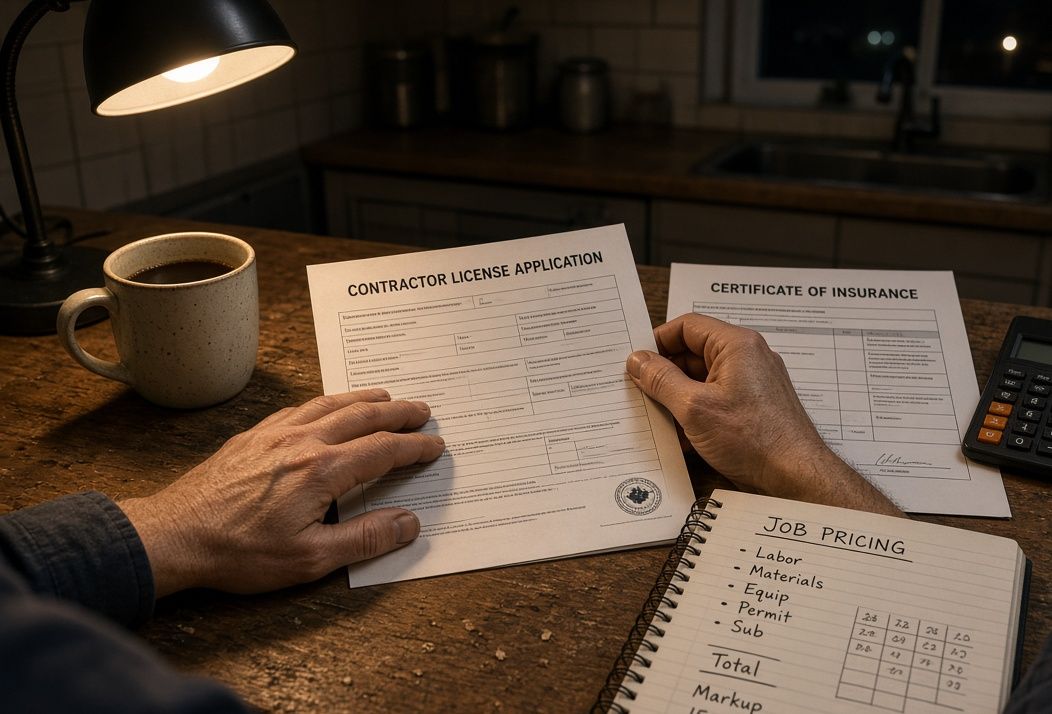
What actually changes
The tools feel the same. Almost everything around them doesn’t.
- No Friday paycheck. You get paid when the customer pays. A slow week is your problem now, not the company’s.
- You are sales, office, and tech. The estimate, the follow-up, the invoice, and the parts run used to be other people’s jobs.
- Taxes are yours. Nothing is withheld. Quarterly estimates and a clean set of books are how you stay out of trouble.
- Liability moved. A mistake on someone else’s job was a bad day. A mistake on your job can be your insurance, your reputation, and if you skipped the paperwork, a lot worse.
- Customers hire a business. They want a written price, a callback, and proof you are insured. Being the best tech on the old crew does not show up on a Google listing.
- Your time splits. Some of the best hours will not be billable. If you don’t protect a little of them for quotes and books, the business eats the evenings.
A first-month order, if the list feels like too much
- Confirm the license and buy the insurance before you advertise.
- Open the business account and write a simple price sheet.
- Put Jobber or Jobtable on the phone and send the next estimate from it.
- Tell ten people you already trust that you are taking work.
- If the books and follow-up are already slipping, hand that layer to an operations partner instead of promising yourself you’ll catch up Sunday.
You already know how to do the work. Going out on your own is learning how the work gets found, priced, billed, and protected. Do those five things and the van with your name on it is a business. Skip them and it is an expensive way to stay busy.
Next step: tradebuilderhq.com for a short discovery call. Bring where you are, even if the first invoice hasn’t gone out yet.